Chapter 5. Spans and subspaces
§5.1 Subspaces
In general, when a vector space lives inside a bigger one, we use the word “subspace”
Given a vector space, many other vector spaces live inside it. This short chapter will introduce the words we use to describe them, but otherwise be rather boring.
The following are examples of subspaces of :
- The subset of polynomials in that are even functions, meaning .
(In , this is equivalent to .) - The subset of polynomials in that are odd functions, meaning .
(In , this is equivalent to .) - The subset of polynomials in such that divides .
- The subset of polynomials in such that . (Here .)
§5.2 Spans
Earlier, we referred to the concept that a set of vectors can be spanning. We can generalize this as follows:
By definition, a span always contains . Colloquially, the way you should think of this in your head is: “ is anything you can make out of ”. In particular, a set of vectors is spanning if is the whole space. So the span measures how much you can make out of .
The first thing you should know about spans is this:
Conversely, if is a subspace of , and , …, form a basis of , then it’s also true that
So spans and subspaces are two ways of expressing the same idea.
§5.3 Subspaces of
§5.4 Completion of bases
Subspaces behave nicely with respect to bases.
§5.5 Direct sums
Let’s return to the quadratic polynomial example
You may have noticed is that somehow the , and terms don’t “talk to each other”. They’re totally unrelated. In other words, we can consider the three sets
Then quite literally consists of the “sums of these sets”. Specifically, every element of can be written uniquely as the sum of one element from each of these sets. This motivates us to write
The notion which captures this formally is the direct sum.
Take the vector space . We can consider it as a direct sum of its -axis and -axis:
Then .
§5.6 Exercises
Exercise 5.9. Take your birthday and write it in eight-digit -- format. Consider the two vectors
For example, if your birthday was May 17, 1994 you would take and .
- Compute the span of those two vectors in .
- Find a current or former K-pop idol who gets a different answer from you when they use their birthday.
Exercise 5.10. Let be a vector space and a subset of (not necessarily finite).
Wrap your head around the following tongue-twister: is subspace is .
Come up with a better (true) tongue-twister.
Exercise 5.11. Let be an -dimensional vector space, let , …, be vectors, and set . Consider the following nine assertions:
- , …, are linearly independent.
- , …, span .
- , …, are a basis of .
- , …, span .
- , …, are a basis of .
- .
- .
- .
- .
Label Figure 1 with the numbers 1 through 9 showing the logical dependencies between these statements. (There are exactly possible valid labellings.)
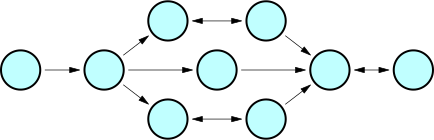
Exercise 5.12.
- Show that the odd polynomials in form a subspace , and compute .
- Show that the even polynomials in form a subspace , and compute .
- Show that .
Exercise 5.14 (*) (Putnam 2003). Do there exist polynomials , , , such that
holds identically?