Chapter 9. Linear maps
Up until now we have looked only at individual vector spaces in isolation. We now study how different vector spaces talk to each other.
§9.1 Definition and examples
Definition 9.1 (Linear map). Let and be vector spaces. A linear map is a function satisfying two axioms:
- We have for any .
- For any and , .
Other words for “map” include “mapping”, “operator”, “transform”, “transformation”, “function”, and “morphism”; we draw no distinction between them. If , we can also write , particularly if we don’t want to bother naming .
Let’s start with some examples in .
The following are all linear transformations from to :
- The constant function where .
- Projection onto the -axis: .
- Rotation by an angle.
- Reflection across a line.
- Projection onto the line .
The formula
is a linear transformation. (If you’ve seen matrix multiplication before, you may recognize this as multiplication by the matrix .)
Here are some more general ones:
- by .
- by .
- by , that is, “evaluation at ”.
More broadly, pretty much every operator you’ll meet in this book is linear. We won’t have any practical use of maps that aren’t linear.
§9.2 Linear maps are determined by a basis
The important principle to understand is that if you know the values of a transformation at enough points, you can recover the rest.
Here’s an easy example to start:
Question 9.3. If is a linear transform and it’s given that
what are the vectors for and ?
Solution.
Here’s another example.
Question 9.4. If is a linear transform and it’s given that
what is ?
Solution.
More generally, the second question shows that if you know and you ought to be able to calculate the output of at any other vector like :
More generally, from understanding the solution to the above two questions, you should understand the following important statement that we’ll use over and over.
Let’s make sure you understand this principle well.
§9.3 Composing linear maps
§9.4 Example: repeatedly applying a map
§9.5 Kernels and images
Suppose is a linear map. There are two important subspaces associated to we’ll define now.
Definition 9.7 (Kernel). Let be a linear map.
The kernel of , denoted , is the subspace of defined by
The kernel is also called the nullspace, but we will never use this term. (I’ve never heard a serious mathematician use this term.)
The image or column space of , denoted , is the subspace of defined by
(We explain why the name “column space” makes sense in the next chapter.)
The theorem Theorem 9.9 gives a picture Figure 13 that shows how you can think about how this.
Theorem 9.9 (Picking a basis for linear maps). Let be a map of finite-dimensional vector spaces, with , . Then there exists a basis , …, of and a basis , …, of , as well as an integer , such that
In particular, and .
Theorem 9.9 is ultra important and forms the foundation for our study of . I’ll even draw a cartoon of it to make sure you remember.
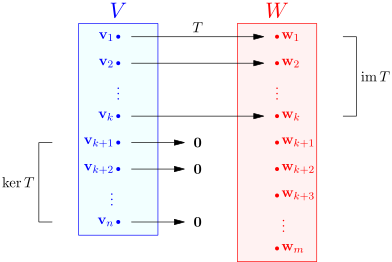
Proof of Theorem 9.9. Let have dimension . We can pick , …, a basis of . Then extend it to a basis , …, of .
I claim that , , …, are linearly dependent. Indeed, if there was some linear dependence between them, we would get
which would mean that the vector was in . But we chose is the span of the other basis vectors , …, so this could only happen if all were .
Hence, are linearly independent in . By definition, they also span the subspace of , and we can complete it to a basis of .
§9.6 Rank
In Phase I, you probably figured out the most important number to know about each vector space was its dimension. Similarly, the most important number about a linear map is its rank: that’s the number in Theorem 9.9 and Figure 13.
Definition 9.10 (Rank). Let be a linear map between finite-dimensional vector spaces. The rank of is defined as
Using this term, we could rephrase the conclusion in Theorem 9.9 as the following corollary:
Corollary 9.11 (Rank-nullity theorem). Let and be finite-dimensional vector spaces. If , then
(Some other textbooks use the word nullity to refer to , but we won’t do so.)
§9.7 Full rank
From Theorem 9.9, we know
We use the words “full rank” to mean “largest possible rank under Theorem 9.9”, that is:
Definition 9.12 (Full rank). Let be a linear map between finite-dimensional vector spaces. We say has full rank if
There are special words for particular cases of “full rank”. However, they may not be obviously related at first:
Definition 9.13 (Injectivity and surjectivity). Let be a linear map.
- We say is injective if, for every , there is at least one such that .
- We say is surjective if, for every , there is at most one such that .
- We say is bijective or an isomorphism if, for every , there is exactly one such that . In this case, we also write .
Depending on your prior education, you may recognize the words “injective”, “surjective”, “bijective” from many other contexts. They aren’t specific to linear algebra; you can use these words for any sort of function. Also, the words one-to-one and onto are older synonyms for “injective” and “surjective”, but we won’t use these words because they are too easy to confuse with each other.
What does this have to do with rank? Because of this:
Theorem 9.15 (Injectivity and surjectivity are special cases of full rank). Let be a linear map, with and finite-dimensional. Then:
- is injective if and only if .
- is surjective if and only if .
- is an isomorphism if and only if .
§9.8 Example: Lagrange interpolation
In a lot of situations, you might already know that In that case, Theorem 9.15 plays a similar role to Proposition 3.17 as a “50% off” result: if you want to be an isomorphism, you only need one of injective or surjective.
Here’s an example application of this situation that might look at first like it comes out of your high school algebra class, since it doesn’t reference linear algebra at all. Don’t worry, it’s related.
When for example, this loosely says there is a unique line joining two points.
Proof. Consider the linear map
This is indeed a linear map because, well, and . The problem is to show that is an isomorphism
Since , by Theorem 9.15, we only need to prove is injective to obtain that it is bijective. Equivalently, we need to show that .
But suppose , meaning . Then has roots at different inputs, yet . So must be exactly the zero polynomial, as desired.
§9.9 Exercises
Exercise 9.18. Let and be finite-dimensional vector spaces with nonzero dimension, and consider linear maps . Complete the following table by writing “sometimes”, “always”, or “never” for each entry.
| injective | surjective | isomorphism | |
| If … | |||
| If … | |||
| If … |
Exercise 9.19 (*) (TSTST 2014). Let and be arbitrary polynomials with real coefficients, and let be the degree of . Assume that is not the zero polynomial. Prove that there exist polynomials and such that
- Both and have degree at most ,
- At most one of and is the zero polynomial,
- divides .
Exercise 9.20. Let be a finite-dimensional vector space. Let be a linear map which is idempotent, meaning for each . Prove that