Chapter 20. Proofs of the dot product property
§20.1 Deriving the geometric definition of dot product from the algebraic one
This proof is short, but harder to come up with.
We have two definitions in play and we want to show they coincide, which makes notation awkward. So in what follows, our notation will always refer to the algebraic definition; and we will prove that .
The algebraic definition is already enough to tell us that
(1)
by the Pythagorean theorem: if then both sides equal .
Let denote the origin, and let and denote the endpoints of and when we draw them as arrows emanating from the origin. Hence is a vector pointing from to .
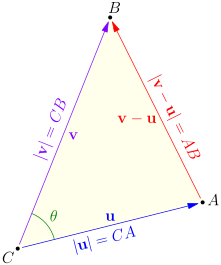
We now use Equation 1 three times as follows:
However, the law of cosines on triangle also tells us that
where is the angle between and . Setting the two equations for equal gives
As and , the proof is complete.
§20.2 Deriving the algebraic definition of dot product from the geometric one
The proof in Section 20.1 might seem magical. Indeed, it’s so short because it’s cheating in some way: it starts with the algebraic definition. But if you’ve never seen the dot product before, that algebraic definition is unnatural; you wouldn’t have any idea to write the expression . So in this section we give a proof that starts from the geometric formula and shows how you would come up with .
So this time our convention is flipped from Section 20.1: in what follows, our notation will always refer to the geometric definition; that is . And our goal is to show that it matches the algebraic definition.
We will assume that (i.e. is a unit vector) so that is the length of the projection of onto . This is OK to assume because in the general case one just scales everything by .
§20.2.1 Easy special case
As a warmup, try to show that if is any vector, then . (This is easy. The projection of onto is literally .)
§20.2.2 Main proof
For concreteness, specialize to and consider where is a unit vector (i.e. ), and is any vector in . Then we want to show that the projection of onto has length . See Figure 20.
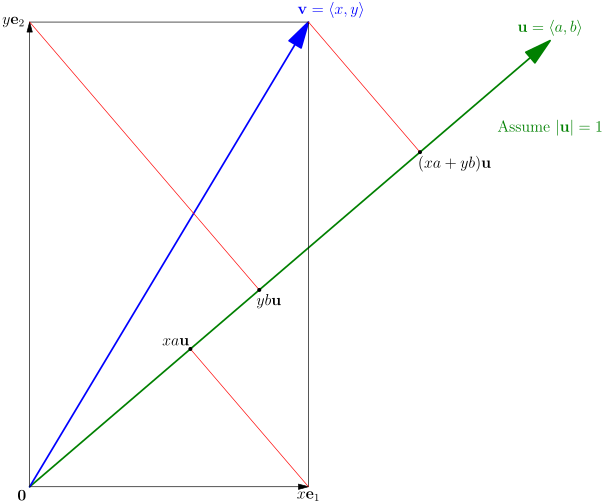
The basic idea is to decompose . The length of projection of onto can be decomposed then into the lengths of projections of and . (To see this, tilt your head so the green line is horizontal; recall that the black quadrilateral is a rectangle, hence also a parallelogram). In other words,
But we already did the special cases before:
Hence, we get the right-hand side is
as advertised. In summary, by using the black parallelogram, we were able to split into two easy cases we already know how to do.
The same idea will work in if you use instead, and replace the parallelogram with a parallelepiped, in which case one now has easy cases. And so on in dimensions.